
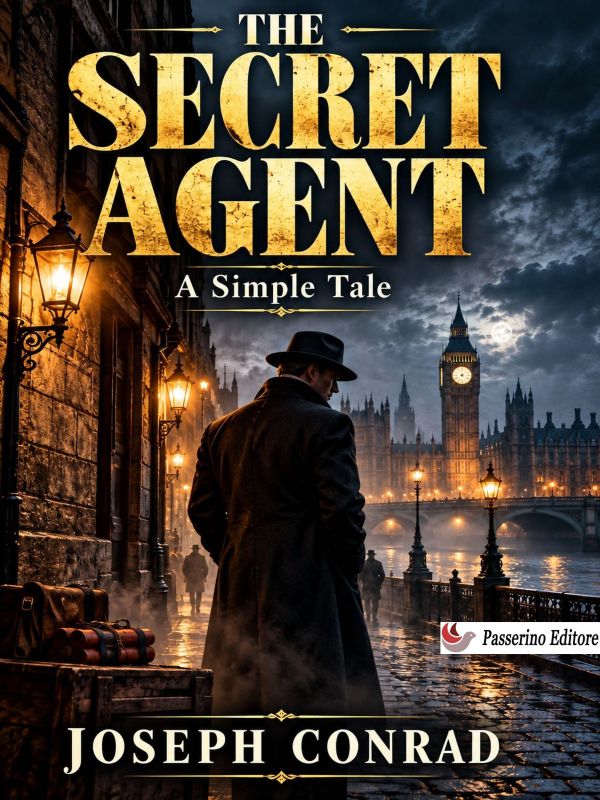
Set in the shadowy streets of Edwardian London, The Secret Agent is one of Joseph Conrad’s most powerful and unsettling novels—a gripping exploration of espionage, anarchism, terrorism, and the dark contradictions of human nature.
Adolf Verloc leads an apparently ordinary life, running a small shop in Soho while secretly working as an informant for a foreign embassy. But when his mysterious employers demand a spectacular act of political violence, Verloc becomes entangled in a dangerous conspiracy that threatens to destroy everything around him. As revolutionaries, spies, police officers, and unsuspecting family members are drawn into a web of deception, the boundaries between loyalty and betrayal, idealism and fanaticism, begin to collapse. Inspired by a real historical incident, The Secret Agent combines psychological depth, biting political satire, and mounting suspense to expose the absurdities of ideological extremism and the devastating consequences of violence.
First published in 1907, this extraordinary novel remains strikingly relevant today, raising disturbing questions about terrorism, state power, manipulation, and the fragile lives caught between competing political forces.
Joseph Conrad (1857–1924) was a Polish-born British novelist widely regarded as one of the greatest writers of English literature. Born Józef Teodor Konrad Korzeniowski in Berdychiv, then part of the Russian Empire, Conrad spent much of his early adulthood working as a sailor, an experience that profoundly influenced his literary imagination.
Although English was his third language, Conrad became a master of English prose, celebrated for his psychological insight, complex narratives, and exploration of morality, imperialism, political corruption, and the darker aspects of human nature.
His most famous works include Heart of Darkness (1899), Lord Jim (1900), Nostromo (1904), The Secret Agent (1907), and Under Western Eyes (1911).
Through his innovative narrative techniques and profound understanding of human psychology, Conrad helped shape modernist literature and influenced generations of writers, including George Orwell, Graham Greene, and William Faulkner.
Buy it on Amazon!


