
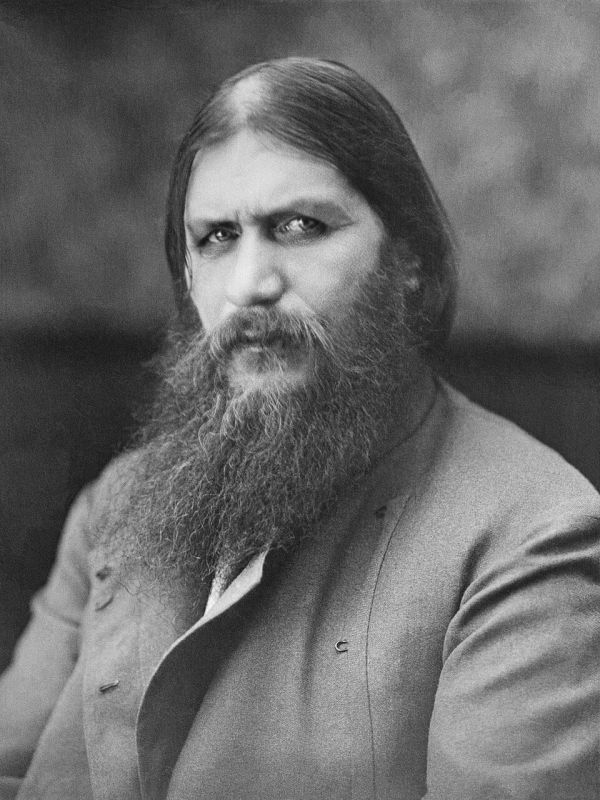
Rasputin fu il famoso avventuriero russo che, nei drammatici anni precedenti la Rivoluzione, riuscì a conquistarsi un sinistro potere alla corte e nell’alta società di Pietroburgo. Nato nella provincia di Tobolsk, in una famiglia di miserabili contadini, si chiamava Novykh, ma fu detto Rasputin (“dissoluto”) per i suoi vizi. Passava il tempo bevendo, sempre tra gente della peggiore risma, e spesso si rese responsabile di furti. Una volta, per aver rubato dei cavalli, fu bastonato a sangue.
Intorno ai trent’anni, abbandonati la moglie e i tre figli, Rasputin cominciò improvvisamente a predicare, terrorizzando i contadini con apocalittici racconti di punizione. Era semianalfabeta, ma dotato di uno sguardo magnetico che soggiogava gli ascoltatori, e presto si guadagnò una fama di santone. Lasciata allora la provincia di Tobolsk, percorse a piedi la Russia, facendosi notare ovunque per la sua foga mistica. Nel 1904 giunse a Pietroburgo, dove ebbe la fortuna di conoscere padre Feofan, un alto esponente del clero, il quale lo presentò alla famiglia del granduca Nikolaj Nikolaevič. In breve tempo Rasputin divenne l’uomo più in vista di Pietroburgo.
«Abbiamo conosciuto — scrisse lo zar Nicola II nel suo diario, in data 1° novembre 1905 — l’uomo di Dio, Grigorij». Rasputin aveva quasi avvinto in un flusso ipnotico l’isterica e superstiziosa imperatrice Alessandra, alla quale prometteva la guarigione dell’emofiliaco zarevič Alessio; ma la sua fortuna va spiegata anche col fatto che egli era appoggiato nell’ombra da alti dignitari religiosi e da politicanti, i quali intendevano servirsi di lui per ottenere favori.
Comunque, in poco tempo, intorno a Rasputin si costituì un gruppo di potere che dominò apertamente la corte. Dapprima Rasputin e i suoi usarono la loro influenza sullo zar per ottenere favori nel campo ecclesiastico, ma poi cominciarono a occuparsi delle cariche pubbliche, giungendo a far nominare a loro piacimento gli stessi ministri di Stato.
Verso il 1910 la potenza di Rasputin era illimitata. Spudorato libertino, aveva avventure continue, e in tutta Pietroburgo si sapeva di ragazze disonorate dallo starec, il “vegliardo”; ma quando riferirono alla zarina che Rasputin «aveva baciato delle donne», ella rispose che anche gli apostoli «baciavano tutti in segno di saluto».
Nel 1911 Rasputin fece nominare vescovo di Tobolsk un suo amico quasi analfabeta, un certo Varnava. In seguito ottenne il licenziamento del primo ministro Kokovcev, che non lo aveva voluto ricevere, e arrivò a presentare allo zar la lista di un nuovo governo.
In realtà, la nobiltà russa viveva anni di terrore e di allucinazione, come in attesa di un pauroso rivolgimento della storia, e in Rasputin vedeva quasi l’incarnazione di un potere soprannaturale da cui sperava protezione. Con tutta la sua volgarità, Rasputin si era trovato davanti a tale società al momento giusto. Tuttavia, il caos da lui provocato negli affari di Stato a un certo momento divenne tale che furono proprio alcuni nobili a decidere di eliminarlo.
La notte tra il 16 e il 17 dicembre 1916, secondo il vecchio calendario, il principe Jusupov, d’accordo con altri congiurati, gli mise del veleno nel vino. Quindi, poiché il veleno sembrava non avere effetto, Rasputin fu ucciso a pistolettate e il suo corpo venne gettato nella Neva.
La morte di Rasputin gettò la coppia imperiale nella costernazione. La zarina, affranta, ne fece recuperare il corpo e volle che fosse sepolto nella cappella imperiale di Carskoe Selo, oggi Puškin.
Rasputín
Rasputín fue el famoso aventurero ruso que, en los dramáticos años previos a la Revolución, logró hacerse con un siniestro poder en la corte y en la alta sociedad de San Petersburgo. Nacido en la provincia de Tobolsk, en el seno de una familia de campesinos miserables, su apellido era Novykh, pero se le conocía como Rasputín («dissoluto») debido a sus vicios. Se pasaba el tiempo bebiendo, siempre rodeado de gente de la peor calaña, y a menudo se vio involucrado en robos. Una vez, por haber robado unos caballos, lo golpearon a palos hasta dejarlo ensangrentado.
Alrededor de los treinta años, tras abandonar a su esposa y a sus tres hijos, Rasputín comenzó de repente a predicar, aterrorizando a los campesinos con relatos apocalípticos de castigo. Era semianalfabeto, pero dotado de una mirada magnética que subyugaba a sus oyentes, y pronto se ganó la fama de gurú. Tras abandonar la provincia de Tobolsk, recorrió Rusia a pie, llamando la atención en todas partes por su fervor místico. En 1904 llegó a San Petersburgo, donde tuvo la suerte de conocer al padre Feofán, un alto representante del clero, quien lo presentó a la familia del gran duque Nikolái Nikoláievich. En poco tiempo, Rasputín se convirtió en el hombre más destacado de San Petersburgo.
«Hemos conocido —escribió el zar Nicolás II en su diario, con fecha del 1 de noviembre de 1905— al hombre de Dios, Grigori». Rasputín había cautivado casi hipnóticamente a la histérica y supersticiosa emperatriz Alexandra, a quien le prometía la curación del zarevich Alexei, quien padecía hemofilia; pero su éxito también se explica por el hecho de que contaba con el apoyo en la sombra de altos dignatarios religiosos y políticos, quienes pretendían valerse de él para obtener favores.
De todos modos, en poco tiempo se formó alrededor de Rasputín un grupo de poder que dominó abiertamente la corte. Al principio, Rasputín y los suyos utilizaron su influencia sobre el zar para obtener favores en el ámbito eclesiástico, pero luego comenzaron a ocuparse de los cargos públicos, llegando incluso a nombrar a su antojo a los propios ministros de Estado.
Hacia 1910, el poder de Rasputín era ilimitado. Libertino descarado, tenía aventuras constantes, y en todo San Petersburgo se sabía de chicas deshonradas por el starets, el «anciano»; pero cuando le informaron a la zarina de que Rasputín «había besado a mujeres», ella respondió que incluso los apóstoles «besaban a todos en señal de saludo».
En 1911, Rasputín logró que nombraran obispo de Tobolsk a un amigo suyo casi analfabeto, un tal Varnava. Posteriormente, consiguió el despido del primer ministro Kokovtsov, quien se había negado a recibirlo, y llegó incluso a presentar al zar la lista de un nuevo gobierno.
En realidad, la nobleza rusa vivía años de terror y alucinación, como a la espera de un temible vuelco de la historia, y veía en Rasputín casi la encarnación de un poder sobrenatural del que esperaba protección. Con toda su vulgaridad, Rasputín se había presentado ante esa sociedad en el momento oportuno. Sin embargo, el caos que él provocó en los asuntos de Estado llegó a tal punto en cierto momento que fueron precisamente algunos nobles quienes decidieron eliminarlo.
La noche del 16 al 17 de diciembre de 1916, según el calendario antiguo, el príncipe Yusupov, de acuerdo con otros conspiradores, le echó veneno en el vino. Luego, como el veneno parecía no surtir efecto, Rasputín fue asesinado a tiros y su cuerpo fue arrojado al río Neva.
La muerte de Rasputín sumió a la pareja imperial en la consternación. La zarina, desconsolada, hizo que recuperaran el cuerpo y quiso que fuera enterrado en la capilla imperial de Carskoe Selo, hoy Pushkin.
Rasputin
Rasputin was the famous Russian adventurer who, in the dramatic years preceding the Revolution, managed to acquire a sinister power at court and within the high society of St. Petersburg. Born in the province of Tobolsk, into a family of impoverished peasants, his surname was Novykh, but he came to be known as Rasputin (“debauched”) because of his vices. He spent his time drinking, always among people of the worst sort, and was often responsible for thefts. Once, after stealing horses, he was beaten bloody.
Around the age of thirty, having abandoned his wife and three children, Rasputin suddenly began to preach, terrifying the peasants with apocalyptic tales of punishment. He was semi-literate, but possessed a magnetic gaze that subjugated his listeners, and soon gained a reputation as a holy man. Leaving the province of Tobolsk, he travelled across Russia on foot, making himself noticed everywhere for his mystical fervour. In 1904 he arrived in St. Petersburg, where he had the good fortune to meet Father Feofan, a high-ranking member of the clergy, who introduced him to the family of Grand Duke Nikolai Nikolaevich. In a short time Rasputin became the most prominent man in St. Petersburg.
“We have met,” Tsar Nicholas II wrote in his diary on 1 November 1905, “the man of God, Grigory.” Rasputin had almost bound the hysterical and superstitious Empress Alexandra in a kind of hypnotic spell, promising her the healing of the haemophiliac Tsarevich Alexei; but his success can also be explained by the fact that he was secretly supported by high-ranking religious dignitaries and political schemers, who intended to use him to obtain favours.
In any case, within a short time a power group formed around Rasputin and openly dominated the court. At first Rasputin and his followers used their influence over the Tsar to obtain favours in ecclesiastical matters, but later they began to concern themselves with public offices, even managing to have ministers of state appointed according to their wishes.
By around 1910 Rasputin’s power was unlimited. A shameless libertine, he had constant affairs, and throughout St. Petersburg people knew of girls dishonoured by the starets, the “elder”; but when the Tsarina was told that Rasputin “had kissed women,” she replied that the apostles too “kissed everyone as a sign of greeting.”
In 1911 Rasputin had a nearly illiterate friend of his, a certain Varnava, appointed Bishop of Tobolsk. Later he obtained the dismissal of Prime Minister Kokovtsov, who had refused to receive him, and even went so far as to present the Tsar with the list of a new government.
In reality, the Russian nobility was living through years of terror and hallucination, as if awaiting some fearful upheaval in history, and in Rasputin it saw almost the incarnation of a supernatural power from which it hoped to receive protection. With all his vulgarity, Rasputin had found himself before such a society at just the right moment. Yet the chaos he caused in affairs of state eventually became so great that it was the nobles themselves who decided to eliminate him.
On the night between 16 and 17 December 1916, according to the old calendar, Prince Yusupov, in agreement with other conspirators, put poison in his wine. Then, since the poison seemed to have no effect, Rasputin was shot dead and his body was thrown into the Neva.
Rasputin’s death plunged the imperial couple into consternation. The Tsarina, grief-stricken, had his body recovered and wanted him buried in the imperial chapel of Tsarskoe Selo, now Pushkin.
Rasputin
Rasputin war der berühmte russische Abenteurer, dem es in den dramatischen Jahren vor der Revolution gelang, am Hof und in der hohen Gesellschaft von Sankt Petersburg eine unheilvolle Macht zu erlangen. Geboren in der Provinz Tobolsk in einer Familie elender Bauern, hieß er eigentlich Novych, wurde aber wegen seiner Laster Rasputin („der Ausschweifende“) genannt. Er verbrachte seine Zeit mit Trinken, stets unter Menschen der übelsten Sorte, und machte sich häufig des Diebstahls schuldig. Einmal wurde er, nachdem er Pferde gestohlen hatte, blutig geschlagen.
Um das dreißigste Lebensjahr herum begann Rasputin, nachdem er seine Frau und drei Kinder verlassen hatte, plötzlich zu predigen und die Bauern mit apokalyptischen Erzählungen von Strafe in Angst zu versetzen. Er war halb analphabetisch, besaß jedoch einen magnetischen Blick, der seine Zuhörer in seinen Bann zog, und erwarb sich bald den Ruf eines heiligen Mannes. Nachdem er die Provinz Tobolsk verlassen hatte, durchwanderte er Russland zu Fuß und machte überall durch seinen mystischen Eifer auf sich aufmerksam. Im Jahr 1904 gelangte er nach Sankt Petersburg, wo er das Glück hatte, Vater Feofan kennenzulernen, einen hohen Vertreter des Klerus, der ihn der Familie des Großfürsten Nikolai Nikolajewitsch vorstellte. In kurzer Zeit wurde Rasputin zum meistbeachteten Mann Sankt Petersburgs.
„Wir haben“, schrieb Zar Nikolaus II. am 1. November 1905 in sein Tagebuch, „den Mann Gottes, Grigori, kennengelernt.“ Rasputin hatte die hysterische und abergläubische Kaiserin Alexandra beinahe in einen hypnotischen Bann geschlagen, indem er ihr die Heilung des an Hämophilie leidenden Zarewitsch Alexei versprach; sein Erfolg erklärt sich jedoch auch daraus, dass er im Verborgenen von hohen geistlichen Würdenträgern und politischen Intriganten unterstützt wurde, die sich seiner bedienen wollten, um Gefälligkeiten zu erlangen.
Jedenfalls bildete sich in kurzer Zeit um Rasputin eine Machtgruppe, die den Hof offen beherrschte. Zunächst nutzten Rasputin und seine Anhänger ihren Einfluss auf den Zaren, um Vorteile im kirchlichen Bereich zu erlangen; später aber begannen sie, sich auch mit öffentlichen Ämtern zu befassen, und gingen so weit, Minister nach ihrem Belieben ernennen zu lassen.
Um 1910 war Rasputins Macht nahezu unbegrenzt. Als schamloser Wüstling hatte er unablässig Affären, und in ganz Sankt Petersburg wusste man von Mädchen, die von dem Starez, dem „Greis“, entehrt worden waren. Als man der Zarin jedoch berichtete, Rasputin habe „Frauen geküsst“, antwortete sie, auch die Apostel hätten „alle zum Zeichen des Grußes geküsst“.
Im Jahr 1911 ließ Rasputin einen fast analphabetischen Freund, einen gewissen Varnava, zum Bischof von Tobolsk ernennen. Später erreichte er die Entlassung des Ministerpräsidenten Kokowzow, der sich geweigert hatte, ihn zu empfangen, und ging sogar so weit, dem Zaren die Liste einer neuen Regierung vorzulegen.
In Wirklichkeit lebte der russische Adel in Jahren des Schreckens und der Wahnvorstellungen, als erwarte er eine furchtbare geschichtliche Umwälzung, und sah in Rasputin beinahe die Verkörperung einer übernatürlichen Macht, von der er Schutz erhoffte. Bei all seiner Vulgarität war Rasputin einer solchen Gesellschaft genau im richtigen Augenblick begegnet. Doch das Chaos, das er in den Staatsangelegenheiten verursachte, wurde schließlich so groß, dass gerade einige Adlige beschlossen, ihn zu beseitigen.
In der Nacht vom 16. auf den 17. Dezember 1916, nach dem alten Kalender, mischte Fürst Jussupow ihm im Einvernehmen mit anderen Verschwörern Gift in den Wein. Da das Gift jedoch keine Wirkung zu zeigen schien, wurde Rasputin anschließend erschossen und sein Körper in die Newa geworfen.
Rasputins Tod stürzte das Kaiserpaar in tiefe Bestürzung. Die Zarin ließ seinen Leichnam, von Schmerz überwältigt, bergen und wollte, dass er in der kaiserlichen Kapelle von Zarskoje Selo, dem heutigen Puschkin, beigesetzt wurde.
Raspoutine
Raspoutine fut le célèbre aventurier russe qui, durant les années dramatiques précédant la Révolution, parvint à s’assurer un pouvoir sinistre à la cour et dans la haute société de Saint-Pétersbourg. Né dans la province de Tobolsk, au sein d’une famille de misérables paysans, il s’appelait Novykh, mais on le surnomma Raspoutine (« le débauché ») en raison de ses vices. Il passait son temps à boire, toujours entouré de gens de la pire espèce, et se rendit souvent coupable de vols. Une fois, pour avoir volé des chevaux, il fut battu jusqu’au sang.
Vers l’âge de trente ans, après avoir abandonné sa femme et ses trois enfants, Raspoutine se mit soudain à prêcher, terrorisant les paysans par des récits apocalyptiques de châtiment. Il était semi-analphabète, mais doué d’un regard magnétique qui subjuguait ses auditeurs, et il acquit bientôt une réputation de saint homme. Ayant alors quitté la province de Tobolsk, il parcourut la Russie à pied, se faisant partout remarquer par son ardeur mystique. En 1904, il arriva à Saint-Pétersbourg, où il eut la chance de rencontrer le père Feofan, un haut représentant du clergé, qui le présenta à la famille du grand-duc Nikolaï Nikolaïevitch. En peu de temps, Raspoutine devint l’homme le plus en vue de Saint-Pétersbourg.
« Nous avons rencontré — écrivit le tsar Nicolas II dans son journal, à la date du 1er novembre 1905 — l’homme de Dieu, Grigori. » Raspoutine avait presque pris dans un flux hypnotique l’impératrice Alexandra, hystérique et superstitieuse, à laquelle il promettait la guérison du tsarévitch Alexis, atteint d’hémophilie ; mais sa fortune s’explique aussi par le fait qu’il était soutenu dans l’ombre par de hauts dignitaires religieux et par des politiciens, qui entendaient se servir de lui pour obtenir des faveurs.
Quoi qu’il en soit, en peu de temps, un groupe de pouvoir se forma autour de Raspoutine et domina ouvertement la cour. Au début, Raspoutine et les siens utilisèrent leur influence sur le tsar pour obtenir des faveurs dans le domaine ecclésiastique ; puis ils commencèrent à s’occuper des charges publiques, allant jusqu’à faire nommer, selon leur bon vouloir, les ministres d’État eux-mêmes.
Vers 1910, la puissance de Raspoutine était illimitée. Libertin éhonté, il avait des aventures continuelles, et tout Saint-Pétersbourg savait que des jeunes filles avaient été déshonorées par le starets, le « vieillard » ; mais lorsque l’on rapporta à la tsarine que Raspoutine « avait embrassé des femmes », elle répondit que les apôtres eux aussi « embrassaient tout le monde en signe de salut ».
En 1911, Raspoutine fit nommer évêque de Tobolsk l’un de ses amis presque analphabète, un certain Varnava. Par la suite, il obtint le renvoi du Premier ministre Kokovtsov, qui avait refusé de le recevoir, et alla jusqu’à présenter au tsar la liste d’un nouveau gouvernement.
En réalité, la noblesse russe vivait des années de terreur et d’hallucination, comme dans l’attente d’un terrible bouleversement de l’histoire, et voyait en Raspoutine presque l’incarnation d’un pouvoir surnaturel dont elle espérait la protection. Malgré toute sa vulgarité, Raspoutine s’était trouvé face à une telle société au moment opportun. Pourtant, le chaos qu’il provoqua dans les affaires de l’État devint finalement tel que ce furent précisément certains nobles qui décidèrent de l’éliminer.
Dans la nuit du 16 au 17 décembre 1916, selon l’ancien calendrier, le prince Ioussoupov, d’accord avec d’autres conjurés, mit du poison dans son vin. Puis, comme le poison semblait ne produire aucun effet, Raspoutine fut tué à coups de pistolet et son corps fut jeté dans la Neva.
La mort de Raspoutine plongea le couple impérial dans la consternation. La tsarine, accablée, fit récupérer son corps et voulut qu’il fût enseveli dans la chapelle impériale de Tsarskoïe Selo, aujourd’hui Pouchkine.


